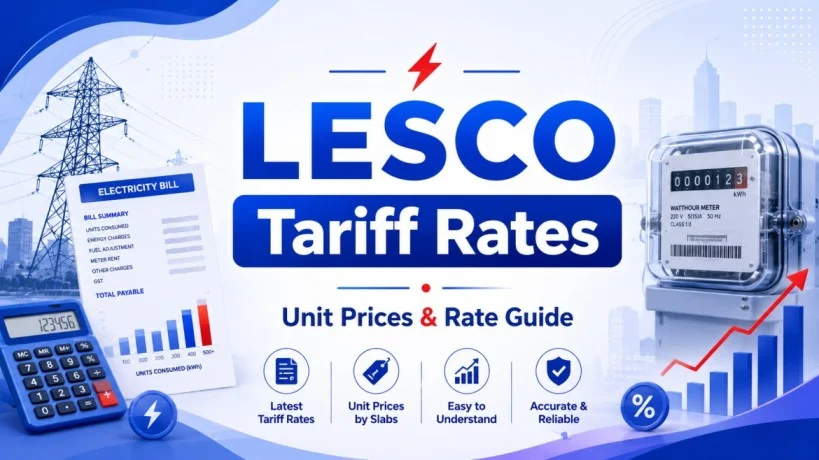
LESCO Tariff Rates 2026: Complete Unit Price Guide for Lahore Consumers
If you’re a homeowner, business owner, or tenant paying electricity bills in Lahore, understanding the LESCO tariff structure is crucial. Your monthly bill doesn’t simply multiply your consumption by a single rate—LESCO uses a tiered, progressive tariff system where your per unit price increases as you consume more electricity. This guide breaks down the exact LESCO unit price, tariff rates, and consumption slabs for 2026, so you can calculate your bills accurately and identify opportunities to save.
What is LESCO Unit Price and How Does It Differ From Tariff?
LESCO unit price is the cost per kilowatt-hour (kWh) you pay for electricity. It sounds simple, but the key is understanding that this price is not fixed—it changes based on how much total electricity you consume in a month.
LESCO tariff, on the other hand, is the entire rate structure including the unit prices, fixed monthly charges, fuel adjustments, and taxes. Think of it this way:
- Unit price = cost per kWh (e.g., Rs. 14.59/unit)
- Tariff = the complete pricing system (e.g., Domestic A-1 tariff includes multiple unit prices, fixed charges, FPA, GST, and surcharges)
Understanding both concepts helps you predict your monthly bill accurately. In 2026, LESCO unit price starts as low as Rs. 3.95 per unit for protected lifeline consumers but can reach Rs. 47.69 per unit for heavy unprotected consumers.
LESCO Tariff Structure Explained: Slabs, Tiers & Protected Status
LESCO uses a progressive tiered tariff system, meaning your rates increase in “slabs” as your monthly consumption rises. You don’t pay one rate for all units—you pay different rates for different consumption levels.

Example: If you consume 250 units:
- First 50 units: Rs. 3.95/unit
- Next 50 units (51-100): Rs. 7.74/unit
- Next 100 units (101-200): Rs. 9.82/unit
- Next 50 units (201-250): Rs. 14.37/unit
This tiered approach incentivizes lower consumption while ensuring higher users pay progressively more.
Protected vs. Unprotected Status:
| Status | Eligibility | Unit Rates | Max Units | Benefits |
|---|---|---|---|---|
| Protected (Lifeline) | Low-income, consumption <200 units/month | Subsidized rates (Rs. 3.95-9.82) | 200 units | Government support for basic needs |
| Unprotected | Consumption >200 units/month | Higher rates (Rs. 14.37-47.69) | Unlimited | Full commercial pricing |
Once your consumption exceeds 200 units in a month, you lose protected status for that billing cycle and pay unprotected rates on excess usage.
Domestic (Residential) LESCO Tariff Rates 2026 – Complete Breakdown
This is where most Lahore consumers fall. Here’s the exact LESCO unit price for each consumption slab in 2026:
| Consumption Range | LESCO Unit Price (PKR/kWh) | Cumulative Cost Example |
|---|---|---|
| 0-50 units (Lifeline) | 3.95 | 50 × 3.95 = Rs. 197.50 |
| 51-100 units (Lifeline) | 7.74 | 50 × 7.74 = Rs. 387.00 |
| 101-200 units (Protected) | 9.82 | 100 × 9.82 = Rs. 982.00 |
| 201-300 units (Unprotected) | 14.37 | 100 × 14.37 = Rs. 1,437.00 |
| 301-400 units (Unprotected) | 16.29 | 100 × 16.29 = Rs. 1,629.00 |
| 401-500 units (Unprotected) | 20.88 | 100 × 20.88 = Rs. 2,088.00 |
| 501-600 units (Unprotected) | 25.43 | 100 × 25.43 = Rs. 2,543.00 |
| 601-700 units (Unprotected) | 38.41 | 100 × 38.41 = Rs. 3,841.00 |
| 700+ units (Unprotected) | 47.69 + fixed charges | Varies |
Fixed Monthly Charge: Rs. 75/month (single-phase) or Rs. 150/month (three-phase)
Why This Progressive Pricing? LESCO implements tiered rates to encourage conservation. Heavy consumers (600+ units/month) typically run air conditioning, industrial equipment, or multiple appliances—they should pay premium rates to manage grid demand.
Commercial LESCO Tariff Rates 2026
Businesses pay significantly higher LESCO electricity tariff rates than residential consumers. Commercial tariffs are designed to reflect the higher operational demands and revenue-generating nature of business use.
Commercial Tariff Categories:
| Load Category | LESCO Per Unit Price | Fixed Charge/kW | Best For |
|---|---|---|---|
| Small Commercial (≤2 kW) | Rs. 27.50/kWh | Rs. 300/kW/month | Small shops, offices |
| Medium Commercial (2-10 kW) | Rs. 31.25/kWh (peak), Rs. 25.75/kWh (off-peak) | Rs. 360/kW/month | Retail stores, clinics |
| Large Commercial (>10 kW) | Rs. 33.25/kWh (peak), Rs. 24.50/kWh (off-peak) | Rs. 380/kW/month | Shopping centers, factories |
Why Higher? Commercial connections consume more power continuously, place stress on the grid during peak hours, and have greater economic capacity to pay. LESCO tariff rates for businesses reflect these operational realities.
Industrial LESCO Tariff Rates 2026
Industrial consumers pay the highest LESCO unit rate due to massive electricity demands. However, they benefit from Time-of-Use (ToU) rate structures that reward off-peak consumption.
| Load Category | Regular Rate | Peak Rate | Off-Peak Rate | Fixed Charge |
|---|---|---|---|---|
| Small Industrial (≤50 kW) | Rs. 34.33/kWh | Rs. 37.89/kWh | Rs. 32.33/kWh | Rs. 500/kW/month |
| Large Industrial (>50 kW) | Rs. 33.83/kWh | Rs. 37.83/kWh | Rs. 32.12/kWh | Rs. 600/kW/month |
Time-of-Use Strategy: Industrial operators can save significantly by shifting energy-intensive operations to off-peak hours (typically 10 PM – 8 AM). This is why many factories run night shifts—the LESCO tariff incentivizes it.
Agricultural LESCO Tariff Rates 2026
Farmers receive the most subsidized LESCO unit price rates to support agricultural productivity.
| Tube Well Size | LESCO Unit Price | Fixed Charge |
|---|---|---|
| Up to 10 HP | Rs. 14.00/kWh (flat rate) | Minimal |
| Above 10 HP | Rs. 16.50/kWh (flat rate) | Varies by load |
Agricultural tariff is flat (non-tiered) and heavily subsidized by the government. This encourages farmers to use electric pumps instead of diesel, promoting clean energy while supporting rural economies.
What’s Included in Your Bill? Fixed Charges, FPA, Taxes & Surcharges
Your LESCO bill isn’t just unit price × consumption. Several additional charges inflate your final amount:

1. Fixed Monthly Charge
- Single-phase: Rs. 75/month
- Three-phase: Rs. 150/month
- Applied regardless of consumption
2. Fuel Price Adjustment (FPA)
- Rs. 3.41 per unit in 2026
- Why? Reflects fluctuations in global oil/gas prices used for electricity generation
- Changes monthly based on NEPRA calculations
- Can be negative (credit) if fuel prices drop
3. General Sales Tax (GST)
- 18% on entire bill
- Exception: Lifeline (protected) consumers are exempt
- For a Rs. 5,000 bill, add Rs. 900 GST
4. Quarterly Tariff Adjustment (QTA)
- Varies monthly
- Reflects company operational costs and efficiency gains/losses
- Typically Rs. 0.50 to Rs. 2.00 per unit
5. Fixed Service Charges for A-3 (Commercial)
- Rs. 175/month (single-phase or three-phase)
- Applied only if no energy consumed
Total Bill Calculation:
= (Units × Unit Price) + (Units × FPA) + (Units × QTA)
+ Fixed Charge + GST 18%
+ Any Late Payment Surcharge (1-2% if paid after due date)
Peak and Off-Peak Hours: Time-of-Use Tariffs Explained
For certain consumer categories, LESCO offers Time-of-Use (TOU) metering, which charges different LESCO per unit price depending on the time of day.
Peak Hours (Expensive):
- Summer: 10 AM – 10 PM (12 hours)
- Winter: 8 AM – 10 PM (14 hours)
Off-Peak Hours (Cheaper):
- Summer: 10 PM – 10 AM (12 hours)
- Winter: 10 PM – 8 AM (10 hours)
Example:
- Peak usage: 100 units × Rs. 37.89/unit = Rs. 3,789
- Off-peak usage: 100 units × Rs. 32.33/unit = Rs. 3,233
- Savings: Rs. 556 for same consumption
Residential consumers with sanctioned load below 5 kW can opt for TOU metering. This is why running air conditioning, water heaters, and washing machines during off-peak hours (late night/early morning) significantly reduces your LESCO tariff costs.
Why LESCO Tariff Rates Change: Fuel Costs, Government Policy & Demand
Your LESCO unit price isn’t arbitrary—several factors influence tariff adjustments:
1. Global Fuel Prices
Pakistan imports coal, natural gas, and oil. Rising international fuel prices directly increase electricity generation costs, forcing LESCO to raise LESCO electricity tariff rates. FPA reflects this fluctuation monthly.
2. Government Subsidies & Policies
- Government mandates lower rates for protected/lifeline consumers
- Political pressure to keep tariff increases below inflation
- Subsidies funded through taxes, leading to periodic rate hikes for unprotected consumers
3. Seasonal Demand
- Summer (April-September): Peak AC usage drives demand → higher unit rates possible
- Winter (October-March): Lower demand → slightly lower rates
- Peak pricing during hot months reflects grid stress
4. Transmission & Distribution Losses
- Line losses during electricity transmission average 15-20%
- Higher losses → higher tariff needed to recover costs
- NEPRA allows rate increases to compensate for infrastructure losses
5. IPP Capacity Payments
Pakistan contracts with Independent Power Producers (IPPs) who demand guaranteed payments regardless of consumption. These “capacity charges” are recovered through tariffs, pushing rates up even during low-demand periods.
How to Calculate Your LESCO Bill Using Unit Price & Tariff Rate
Step-by-Step Calculation:
Your Consumption: 250 units (Domestic Unprotected)
| Step | Calculation | Amount |
|---|---|---|
| Units 1-50 (Lifeline) | 50 × Rs. 3.95 | Rs. 197.50 |
| Units 51-100 (Lifeline) | 50 × Rs. 7.74 | Rs. 387.00 |
| Units 101-200 (Protected) | 100 × Rs. 9.82 | Rs. 982.00 |
| Units 201-250 (Unprotected) | 50 × Rs. 14.37 | Rs. 718.50 |
| Subtotal (Energy Charges) | Rs. 2,285.00 | |
| FPA (250 × Rs. 3.41) | Rs. 852.50 | |
| Fixed Monthly Charge | Rs. 75.00 | |
| Subtotal (Before Tax) | Rs. 3,212.50 | |
| GST 18% | Rs. 3,212.50 × 0.18 | Rs. 578.25 |
| Final Bill | Rs. 3,790.75 |
Your average unit price = Rs. 3,790.75 ÷ 250 units = Rs. 15.16/unit
Notice: Even though the basic unit prices range from Rs. 3.95 to Rs. 14.37, your effective per-unit cost including FPA and GST is Rs. 15.16. This is why understanding LESCO tariff structure is essential for budgeting.
Frequently Asked Questions (FAQs)
Final Thoughts
Understanding LESCO tariff rates 2026 and your exact per unit price empowers you to make informed decisions about electricity consumption. The tiered tariff system incentivizes conservation—every unit saved in a lower slab protects you from moving into higher slabs.
For Lahore residents, the key takeaway: know your consumption slab, monitor FPA changes, and shift energy-intensive tasks to off-peak hours. A 250-unit consumer paying Rs. 15-16 per unit (effective) can reduce this to Rs. 12-13 by cutting usage 50 units and shifting AC use to late evening.
Your LESCO tariff bill is transparent and calculated by clear formulas. Use this guide to verify your monthly bill accuracy and identify savings opportunities.
LESCO Tariff 2026 — Quick Reference Chart
- Lifeline Unit Price: Rs. 3.95 (0-50 units), Rs. 7.74 (51-100 units)
- Protected Unit Price: Rs. 9.82/unit (101-200 units)
- Unprotected Unit Price: Rs. 14.37 to Rs. 47.69/unit (201+ units)
- Commercial Unit Price: Rs. 27.50 to Rs. 33.25/unit (peak), Rs. 24.50 to Rs. 25.75/unit (off-peak)
- Industrial Unit Price: Rs. 34.33/unit (regular), Rs. 37.89/unit (peak), Rs. 32.33/unit (off-peak)
- Agricultural Unit Price: Rs. 14.00 to Rs. 16.50/unit (flat rate)
- Fuel Price Adjustment (FPA): Rs. 3.41/unit (2026 average)
- GST: 18% on total bill (except lifeline)
- Fixed Monthly Charge: Rs. 75 (single-phase), Rs. 150 (three-phase)