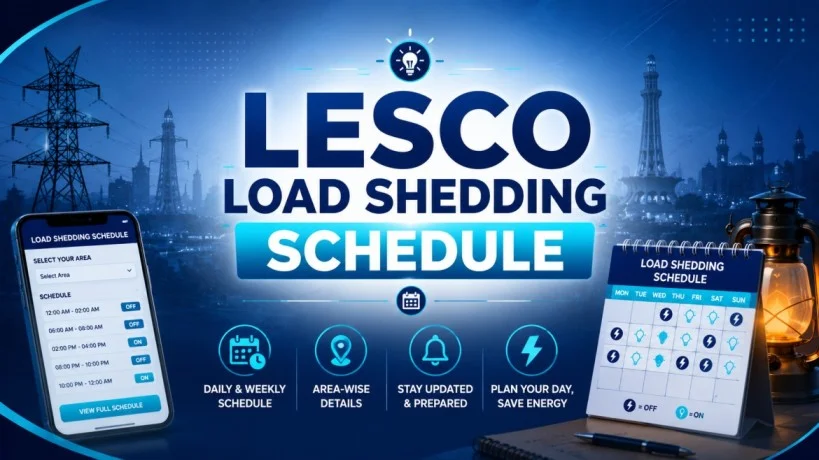
LESCO Load Shedding Schedule 2026 – Check Your Feeder Schedule Online
Your electricity is about to go off. Or it just came back on. Or you are trying to decide whether to run the washing machine, charge your phone, or use the air conditioner — but you do not know when the next power cut will hit. This uncertainty defines life in Lahore, Kasur, Okara, and Sheikhupura if you are a LESCO consumer. Load shedding is planned. It follows a schedule. But most people do not know how to find it.
This guide shows you exactly how to check your LESCO load shedding schedule in 2026 — in 30 seconds, using just your Reference Number. You will learn what the schedule means, why it changes, which areas face longer outages, and how to plan your day around power cuts. By the end, you will never be caught off guard by a blackout again.
What is Load Shedding and Why Does LESCO Do It?
The Simple Definition
Load shedding is when LESCO intentionally cuts electricity to certain areas for a planned period. It is not a breakdown. It is not a punishment. It is a controlled strategy to prevent the entire grid from crashing.
Think of it like this: Imagine a water reservoir that supplies a city. During summer, demand for water goes up (everyone is watering gardens and filling pools). If the reservoir has only enough water for 70% of what the city needs, it has three choices:
- Do nothing — the reservoir runs dry and everyone gets no water
- Ration fairly — everyone gets water for 8 hours and no water for 4 hours on a rotating schedule
- Charge more — make water so expensive that only rich people use it
LESCO chose option 2: rotating shutdowns. Electricity demand in Pakistan peaks in summer when every home runs air conditioning. Supply cannot keep up. So LESCO divides the city into feeders and rotates power off in each area for a scheduled period — typically 2 to 6 hours per day, depending on your area’s recovery zone.
Why Load Shedding is Necessary (But Still Frustrating)
Load shedding prevents total blackouts. Without it, Pakistan’s national grid frequency would drop so low that power plants would shut down automatically, leaving the entire country without electricity for hours. Controlled, planned shedding is better than uncontrolled collapse.
That said: Yes, it is frustrating. Yes, it affects productivity and comfort. Yes, some areas face more shedding than others. Understanding your schedule is the first step to adapting.
LESCO Load Shedding Schedule – Explained in Plain Terms
When you check your LESCO load shedding schedule online, you will see information like this:
| Field | What It Means |
|---|---|
| Feeder Code | A code like “LHR-01-G01-F23” — identifies your specific power line |
| Feeder Name | The area name (e.g., “Gulberg Circle II”) |
| Grid Station | The main transformer hub your area connects to |
| Total Planned Hours | E.g., “4 hours” = your area will have no power for 4 hours today |
| Schedule (OFF Times) | E.g., “2:00 PM to 4:00 PM, 8:00 PM to 10:00 PM” = two 2-hour windows when power is cut |
| Actual Hours Yesterday | How long the power was actually off yesterday (may differ from plan due to grid changes) |
| Actual Hours Today | Running count of outages so far today |
| Electricity Losses | A percentage showing how much electricity is lost or stolen in your area (higher = longer outages) |
The most important line is OFF Times. This tells you exactly when your power will be cut today and tomorrow.
Why this matters: Load shedding is announced in advance by area and feeder, not randomly. This means you can plan your critical activities — charging devices, cooking, laundry, work calls, helpline — outside your area’s OFF windows.
How to Check Your LESCO Load Shedding Schedule in 30 Seconds
You need just one piece of information: your 14-digit Reference Number. Find it on any LESCO bill in the top-left corner. It looks like this: 12-34567-8901234 (the last letter U or R is not needed).

Method 1: Online via LESCO Official Websites (Fastest)
Visit any of these websites:
- lesco.com.pk/load-shedding-schedule
- lesco-online.com.pk (unofficial portal)
- elescobill.com/lesco-load-shedding-schedule
- lesco.light (official portal)
A box will appear asking for your Reference Number. Enter the 14 digits (without dashes, without spaces, without the U/R letter). Click “Check Schedule” or “Submit.”
Within 1 second, your feeder’s load shedding schedule appears showing:
- Your area name
- Today’s OFF times (when power will be cut)
- Tomorrow’s schedule
- Total planned hours for today
This is the fastest, most accurate method. I really suggest bookmarking this page — you will visit it daily during summer.
Method 2: CCMS Portal (For More Detailed Information)
Visit the official LESCO CCMS portal at ccms.lesco.gov.pk. Log in with your Reference Number and CNIC. Click on “Load Management” or “Feeder Details.”
The portal shows:
- Feeder-wise breakdown (your specific power line)
- Grid station name
- Electricity losses in your area
- Planned shedding hours
- Actual shedding hours (historical data)
- Expected restoration time
This method gives you more data but takes slightly longer (2 to 3 minutes).
Method 3: LESCO LIGHT Mobile App (On Your Phone)
Download the official LESCO LIGHT app from Google Play Store or Apple App Store.
- Install and open the app
- Tap the “Load Management” button (home screen)
- Enter your 14-digit Reference Number
- Tap “Submit”
- The app displays your area’s load shedding schedule instantly
The LESCO LIGHT app also lets you:
- Check your bill
- Lodge complaints
- Track complaint status
- Apply for new connections
All in one place. The load shedding feature is real-time and updates every hour.
Method 4: SMS Service (For No-Internet Situations)
Text your Reference Number to 8800 or 1000 (exact code varies; check LESCO’s website for your area’s SMS shortcode). You will receive your today’s and tomorrow’s load shedding schedule via return SMS within 1 minute.
This method works on any phone with SMS ability — even old phones without internet.
Pro tip: If you are away from home and need to know if the power is currently off or will be off soon, use Method 3 (LESCO LIGHT app) — it is always in your pocket.
Understanding Your Feeder Code and Load Shedding Hours
Every LESCO consumer belongs to one of 2,150+ feeders. Your feeder code identifies your exact power line. For example:
- Feeder Code: LHR-99-G45-F102
- Breakdown:
- LHR = Lahore
- 99 = Circle (administrative zone)
- G45 = Grid Station 45 (the transformer hub serving your area)
- F102 = Feeder 102 (your specific power line)
Each feeder has a unique schedule. Feeder LHR-99-G45-F102 might have 4 hours of daily shedding, while the feeder next door has 6 hours. Why? Because electricity losses, theft rates, and demand vary by area.
Interpreting Your Scheduled Hours
When you see “4 hours planned for today,” this does not mean one 4-hour blackout. It usually means two 2-hour windows or four 1-hour windows spread throughout the day.
Example schedule:
OFF: 2:00 PM – 3:00 PM (1 hour)
ON: 3:00 PM – 5:00 PM (2 hours)
OFF: 5:00 PM – 7:00 PM (2 hours)
ON: 7:00 PM – 9:00 PM (2 hours)
OFF: 9:00 PM – 10:00 PM (1 hour)
Total OFF time: 4 hours (split across three windows).
This rotation allows different areas to share the available electricity throughout the day. No single area goes dark for the entire day.
Practical tip: The ON windows are your charging windows. Charge phones, power banks, and laptops during these slots. Run high-power appliances (AC, water pump, microwave) during ON time only.
Why Your Area’s Schedule is Different From Your Neighbor’s
Your neighbor’s feeder might have 2 hours of daily shedding while yours has 6 hours. This is not random. It is based on recovery zones — a classification system LESCO uses to assign shedding fairly (or unfairly, depending on your perspective).

Three Recovery Zones
High Recovery Zone: Minimal to no load shedding (0-1 hour/day)
- Areas with excellent bill payment rates
- Low electricity theft
- Low transmission losses
- Usually: upscale neighborhoods (e.g., some parts of Gulberg, Bahria Town)
Medium Recovery Zone: Moderate shedding (2-6 hours/day)
- Acceptable bill payment rates
- Some electricity theft but manageable
- Average transmission losses
- Usually: middle-class residential areas
Low Recovery Zone: Heavy shedding (8-12 hours/day)
- Poor bill payment rates
- High electricity theft
- High transmission losses
- Usually: industrial areas, low-income neighborhoods, rural areas
Why this system exists: LESCO argues that areas with high electricity theft lose so much power during transmission that they create an imbalance. So they assign more shedding to those areas. Consumers in these areas argue it is unfair — they are punished for their neighbors’ theft.
The reality: Where you live determines how much your power is cut. This is not your fault. It is the feeder’s loss rate.
LESCO Light App – Check Schedule on Your Phone
The LESCO LIGHT mobile app is the fastest, most convenient way to check your schedule daily.
Installation (One-Time)
- Open Google Play Store (Android) or Apple App Store (iOS)
- Search “LESCO LIGHT”
- Install the official app by LESCO/PITC
- Open the app
Checking Your Load Shedding Schedule
On the home screen, you will see several buttons:
- Load Management ← Tap this for your shedding schedule
- Bill Payment
- Lodge Complaint
- Track Complaint
- New Connection
Tap Load Management. Enter your 14-digit Reference Number. Tap Submit.
The app displays (in real-time):
- Grid station name and feeder code
- Today’s Planned OFF Hours: E.g., “4 hours”
- Today’s OFF Schedule: The exact time windows (e.g., 2 PM-3 PM, 5 PM-7 PM, 9 PM-10 PM)
- Tomorrow’s Planned OFF Hours
- Actual Hours Shed Yesterday
- Losses in Your Area: A percentage showing electricity theft/theft in your feeder
Updates happen every hour. If LESCO changes the schedule due to an emergency, the app updates automatically.
I really suggest enabling app notifications. Most versions of LESCO LIGHT allow push notifications for schedule changes. This way, if LESCO extends shedding due to a grid emergency, you get an alert before your power goes off unexpectedly.
Scheduled Maintenance vs. Unscheduled Load Shedding
Not all power cuts follow the load shedding schedule. LESCO distinguishes between two types:
Scheduled Load Shedding (Planned Outages)
These are listed in the schedule you check online. LESCO announces them 24 hours in advance. They are predictable and follow a rotation. Most outages fall here.
Example: “2 PM-3 PM, 5 PM-7 PM, 9 PM-10 PM” — three windows, 4 hours total.
Unscheduled Maintenance Shutdowns
LESCO sometimes cuts power outside the regular schedule to:
- Repair a damaged transformer
- Clear a tree branch from power lines
- Upgrade electrical infrastructure
- Address a technical fault on a specific feeder
These are announced only 1 to 2 hours beforehand via SMS. They do not follow the feeder rotation — they can happen to any area anytime.
Example: “Due to transformer maintenance on Feeder LHR-99-G45-F102, power will be suspended from 10 AM to 1 PM today.”
Maintenance shutdowns are shorter (usually 1 to 3 hours) but unpredictable. This is why checking your schedule online is not 100% reliable — maintenance outages can add extra hours.
Survival tip: If your schedule shows OFF from 2-3 PM but power goes out at 1:30 PM, check your LESCO LIGHT app immediately. A maintenance shutdown may have been announced.
Seasonal Load Shedding Changes – Summer vs. Winter
Your load shedding hours are not the same year-round. They change dramatically by season.
Summer (May-September): Maximum Shedding
- Peak hours: 2 PM to 11 PM (hottest period)
- Every home runs air conditioning
- Industrial demand is high
- Typical shedding: 4-6 hours/day in medium recovery zones
- Extended hours: Can reach 8-12 hours/day in low recovery zones
Spring/Fall (March-April, October-November): Moderate Shedding
- Demand declining but still above average
- AC use reduces to evening hours only
- Typical shedding: 2-4 hours/day
Winter (December-February): Minimal Shedding
- Heating demand (via gas, not electricity) is high
- AC completely off in most homes
- Electricity demand at yearly low
- Typical shedding: 0-2 hours/day or sometimes none
- Some feeders may have zero shedding
Summer is your hardest season. If you live in a low-recovery feeder, expect 8-12 hours daily of power cuts from June to August. Plan accordingly: stock water in advance, buy a power bank, use a gas stove if possible.
High-Loss Areas and Extended Outages – Why?
You may have noticed that your area faces longer shedding than a neighbor’s. The reason is often listed right in your load shedding schedule: Losses: 28% or Losses: 42%.
What Do These Losses Mean?
Electricity losses are the percentage of power lost during transmission from the power plant to your home. Losses occur due to:
- Electricity Theft: Illegal connections tapping into power lines
- Technical Losses: Power dissipated as heat in old, long power lines
- Meter Tampering: Consumers bypassing meters to reduce billing
- Infrastructure Decay: Old, damaged lines losing power
A healthy feeder has 5-10% losses. A problematic feeder has 30-50% losses.
The Unfair Math
If LESCO has 100 MW of power to distribute and a feeder loses 40% during transmission, that feeder can only deliver 60 MW to consumers. So LESCO reduces shedding to that feeder to compensate — which means longer outages in that area to “balance” the load across all feeders.
Example:
- Feeder A (5% losses, high-recovery area): 1 hour shedding/day
- Feeder B (40% losses, low-recovery area): 10 hours shedding/day
LESCO’s argument: “Feeder B has more theft, so the grid is more unbalanced there. Shedding longer hours reduces peak load in that feeder, making the system stable.”
Consumer’s argument: “We are being punished for our neighbors’ theft, which is not our fault.”
Both arguments have merit.
The takeaway: If you live in a high-loss area, you will face longer shedding. This is a structural problem, not something you can fix as an individual. Escalate to NEPRA (the electricity regulator) if you believe the losses are being calculated unfairly.
How to Plan Your Day Around LESCO Shutdowns
Knowing your schedule is only half the battle. The real skill is planning your life around it.
Morning Routine (Before Shedding Starts)
If your first OFF window is 2 PM-3 PM, use morning hours (7 AM-2 PM) to:
- Do laundry (washing machine needs power)
- Iron clothes
- Cook food (microwave or electric stove)
- Charge all devices (phone, laptop, power banks, fans)
- Fill water tanks (water pump needs power)
- Run air conditioning if it is hot
By 2 PM, your phone should be 100%, your water tanks full, your food cooked, and your work devices charged.
During OFF Windows (No Power)
- Do things that do not require electricity: Reading, exercise, socializing
- Use a power bank for essential communications
- Do not turn on appliances when power returns — wait 2 minutes (prevents electrical surges)
- If you use a water pump, fill your overhead tank before the OFF window
During ON Windows (Power Available)
- Run high-power appliances immediately
- Charge devices
- Cook meals (use electric stove while you can)
- Fill water tanks again
- Run washing machine
Evening Smart Scheduling
If your schedule is OFF from 5 PM-7 PM (dinner time), this is critical:
- Cook dinner during 3 PM-5 PM ON window
- Use a thermos or insulated container to keep food hot
- Alternatively, use a gas stove for dinner (if you have gas connection)
- Charge phone/laptop during the 3 PM-5 PM window
Pro strategy: Study your week’s schedule carefully. Some days have more favorable windows than others. Plan your most important tasks (client calls, important work, laundry) for days when shedding is lighter or occurs at convenient times.
Frequently Asked Questions (FAQs)
Final Thoughts
Your LESCO load shedding schedule is not a secret. It is not hidden. It is published online, updated hourly, and accessible in 30 seconds via your Reference Number.
The power cut you fear is not random. It is planned. It is rotating. It is fair (or unfair, depending on your recovery zone). But it is predictable — and that is your advantage.
Stop waiting for the lights to go off. Stop guessing when you can cook, charge your phone, or fill water. Check your schedule today on LESCO LIGHT or at lesco.com.pk/load-shedding-schedule. Bookmark it. Check it daily. Plan your life around it.
By doing this simple thing — checking your schedule — you take back control from load shedding. You stop being a victim of blackouts. You become someone who planned ahead.
You can also verify your feeder’s real-time status directly through LESCO’s official Load Shedding Shutdown Schedule portal.
Start today. Check your schedule right now.